The Signal Quality Problem
A scalping indicator fires a signal when its underlying logic identifies a potential entry. The problem is that most scalping indicator logic is too simple: a crossover of two moving averages, a stochastic threshold, or a price action pattern. Any single condition like this will fire frequently on a short timeframe because markets constantly create short-term fluctuations that trigger the pattern.
On a 1-minute or 5-minute chart, the noise-to-signal ratio is far higher than on a 1-hour or 4-hour chart. A signal that captures 40% of short-term moves sounds reasonable until you account for transaction costs, spread, slippage, and the cognitive cost of monitoring that volume of trades. The solution is not to make the single condition more complex — it is to require multiple independent conditions to agree before firing.
Four Layers of Confirmation
The layered confirmation approach builds a signal engine that checks conditions in sequence. Each layer must pass before the next is evaluated. Only when all four pass simultaneously does the signal fire. This is different from scoring, where conditions contribute to a total and the signal fires when the total exceeds a threshold. In a layered system, all four must pass — there is no averaging or trading one condition off against another. A perfect score on three conditions with a fail on the fourth is still a no-signal outcome.
The four layers address four distinct aspects of market condition: direction, momentum, macro context, and confluence. Each layer is independent — they do not use the same underlying data. This independence is what makes the combination more powerful than any single sophisticated indicator would be.
Layer 1: Supertrend Direction
The Supertrend indicator uses ATR to define dynamic support and resistance bands above and below price. When price closes above the upper band, the trend is bullish. When price closes below the lower band, the trend is bearish. Direction flips are the primary signal layer — they identify when the short-term trend has changed.
A key constraint is the minimum hold requirement. A Supertrend that flips direction on every candle is not providing useful directional information. Requiring the trend to hold for a minimum number of bars before a flip is treated as a valid reversal filters out the rapid direction changes that occur in choppy markets. This is what prevents the first layer from generating signals constantly during ranging conditions.
Layer 2: ADX Strength Filter
The Average Directional Index measures trend strength without regard to direction. A high ADX means price is trending strongly — there is persistent directional movement. A low ADX means the market is ranging. The ADX strength filter requires ADX to be above a configured threshold before a signal proceeds. This is the critical layer that kills signals in ranging markets.
During a range, price oscillates between support and resistance. Supertrend will eventually flip — either genuinely or due to noise — but ADX will remain low because there is no trending force behind the movement. The ADX filter catches signals that passed Layer 1 due to coincidental patterns but are occurring in conditions where the strategy has no edge. An ADX threshold of 20–25 is appropriate for most instruments.
Layer 3: EMA Macro Bias
The third layer introduces macro context via a 500-period EMA — a moving average long enough to define the dominant trend across an entire trading session. When price is above the 500-period EMA, the macro bias is bullish; below, it is bearish. By default, the EMA macro bias is informational rather than a hard filter — it is displayed on the dashboard and contributes to the A+ confluence marker, but does not automatically block signals.
For traders who want to scalp only in the direction of the macro trend — a simpler and often more consistent approach — the EMA bias can be set as a hard filter. This blocks any signal that does not align with the 500-period EMA direction, resulting in fewer total signals but a higher percentage of winners on trending days.
Layer 4: Order Block Confluence
The fourth layer is optional but significant. When a scalping signal fires inside an active order block — an institutional supply or demand zone — it receives a confluence marker. This indicates that the signal is occurring at a level where large participants have previously placed orders, adding a structural reason for the signal beyond momentum and direction alone.
Order block confluence signals are a subset of all signals — not every scalping entry will align with an order block. Those that do carry higher conviction because two independent methods point to the same entry location: the signal engine says conditions are aligned, and the order block says this is a location where institutions have previously defended price. Prioritising confluence-marked entries over non-confluence ones is a natural quality filter on mixed signal-quality days.
Why Zero Repaint Is Non-Negotiable
Repainting occurs when an indicator changes historical values as new data arrives. An indicator that appears to have called every move correctly in hindsight, but generates different signals in real time, is providing misleading information that cannot be traded profitably.
For scalping specifically, repainting is particularly destructive. On a 1-minute chart, you are making entry decisions within seconds of a candle closing. If the signal that prompted your entry disappears by the time the next candle closes, you have entered a trade based on information that does not exist in the live feed. Zero repaint requires all conditions to be evaluated on confirmed bar close with no lookahead. The signal you see at bar open — based on the previous bar’s confirmed data — cannot change. This is a non-negotiable requirement for any indicator intended for live scalping.
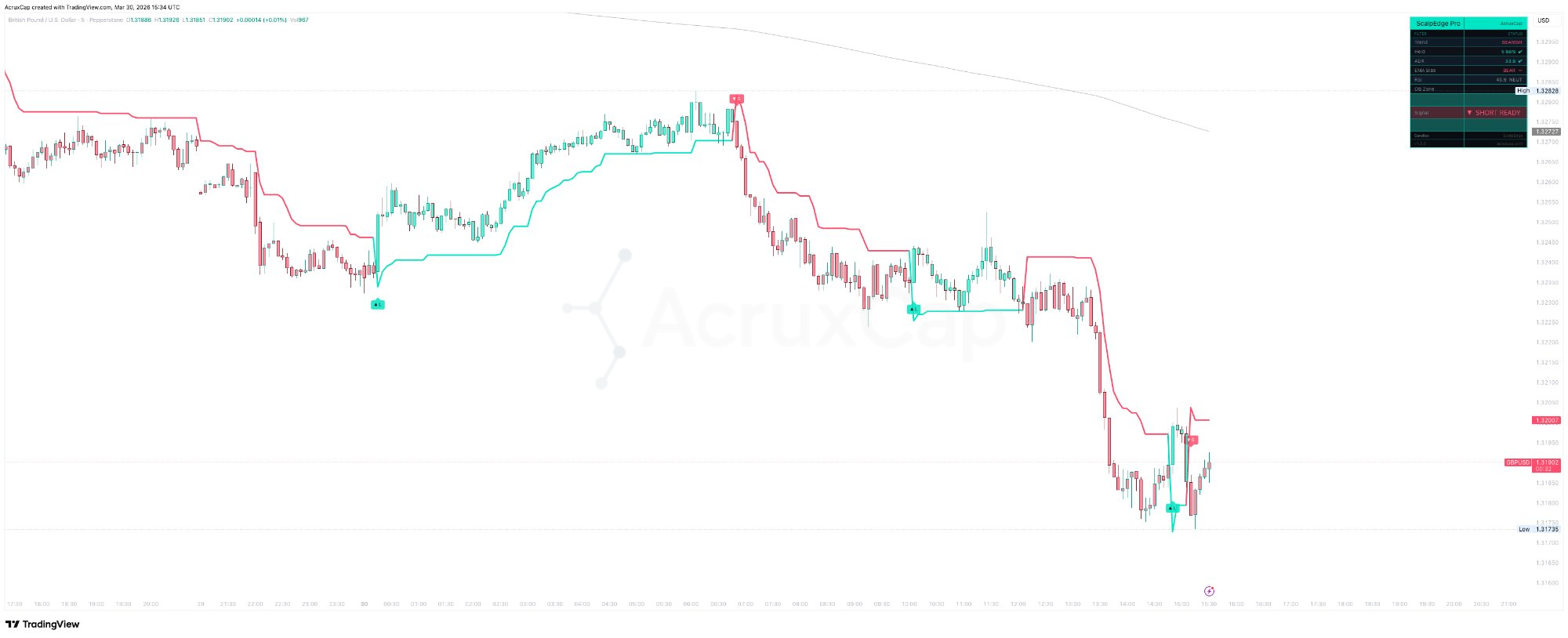
ScalpEdge Pro
ScalpEdge Pro implements four independent signal layers — Supertrend direction with minimum hold requirement, ADX strength filter, 500-period EMA macro bias, and optional order block confluence. A+ signals fire when a signal aligns with an active order block. All signals confirmed on bar close — zero repaint by construction. Eight alert conditions including confluence-specific alerts for webhook integration.