Pulse detects EMA pullback entries when the trend is clear, and VWAP fade entries when price overextends — on US500 and NAS100. Session-anchored VWAP, opening range, pre-market levels, RSI(2) daily bias gate, and full visual trade management with TP1, TP2 and time stops.
Trend and fade entries, VWAP, ORB, pre-market range and trade boxes running on a real chart — showing exactly what you see when you add Pulse By AcruxCap to your TradingView workspace.
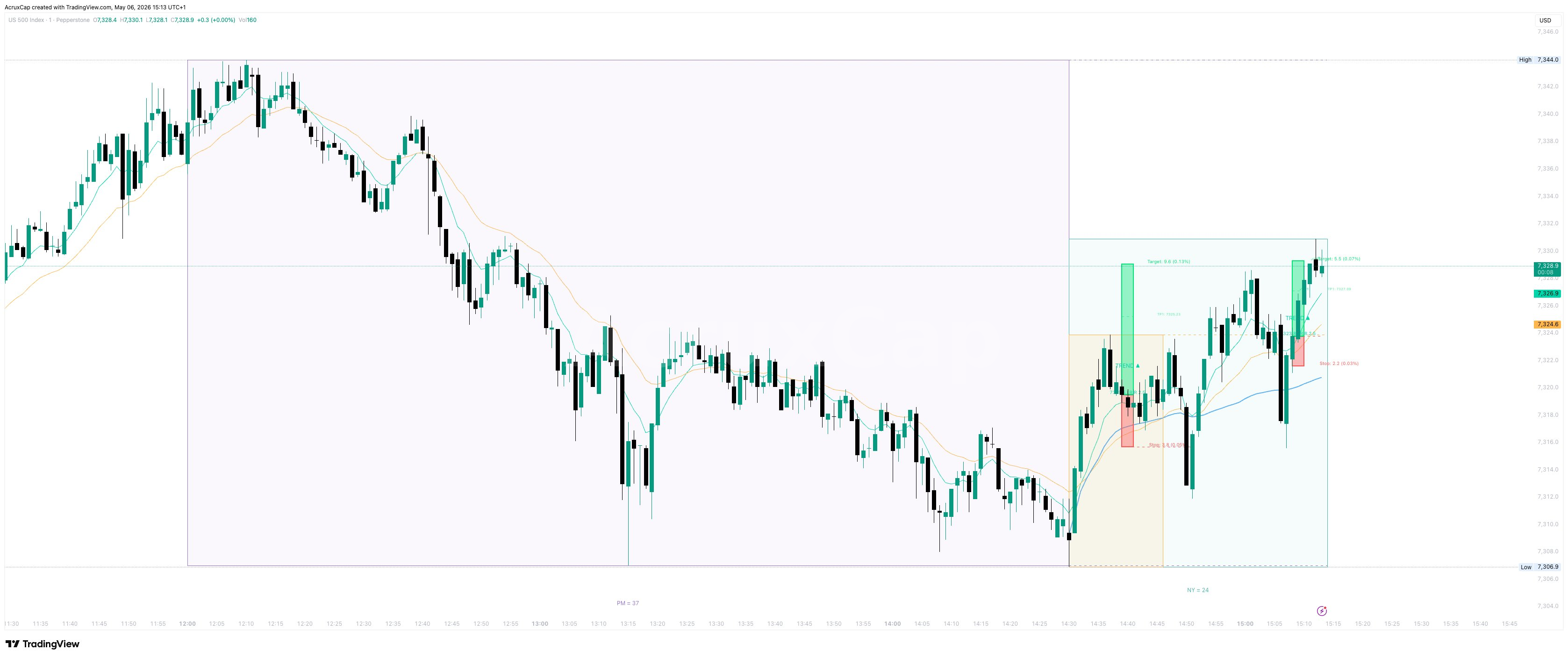
Trend and fade entries visible — Asia (purple), London (slate), and New York (green) — each showing their pip range. The dashboard in the top-right displays session status, directional bias, and HTF EMA alignment across the 1H, 4H, and Daily timeframes.
When the 8 EMA is above the 21 EMA and price is above VWAP, Pulse watches for pullbacks to the fast EMA. You see exactly when each session opened, where its range sits, and how wide it’s been.
Turn sessions on or off with a single click. London, Asia and New York are enabled by default — but if you trade the Sydney open or watch the Frankfurt pre-market, they’re one toggle away.
Every session box shows its pip range live, so you can gauge session volatility at a glance without measuring anything manually.
PDH/PDL, PWH/PWL and PMH/PML are drawn automatically at the start of each new day, week and month. No need to plot them yourself. No need to remember where they were.
When price crosses through a level, it doesn’t just disappear — it fades to a muted style with a ✗ marker. You can still see the level existed and was taken, which matters when you’re reading what happened during a session you weren’t watching.
Show the exact price next to each level. Choose your own colours, line styles and widths. Every level pair is independently customisable.
Every session automatically adjusts when the clocks go forward or back. UK BST, US DST, EU summer time and Australian AEDT are all detected and applied — no manual changes, no missed sessions, no misaligned boxes.
Tokyo correctly stays fixed because Japan doesn’t observe daylight saving. We thought of that too.
If you prefer manual control, you can override any session time in the settings.
The opening range box captures the first 15 minutes of the London and/or New York session — adjustable from 5 to 60 minutes depending on your strategy.
When enabled, the OR high and low extend as horizontal lines through the rest of the session. You can see at a glance whether price is trading above or below the opening range — and when it breaks, you’re ready.
Whether you trade OR breakouts, OR fades, or just use the opening range as context for later entries — the levels are always there.
A compact dashboard sits in the corner of your chart and tells you: which sessions are live and which have closed, each session’s range in pips, whether each session is bullish, bearish or flat, your key levels and whether they’ve been crossed, and higher-timeframe trend alignment across the 1H, 4H and Daily.
Move it to any corner. Change the text size. It’s designed to give you maximum information with minimum screen real estate.
Part of the AcruxCap 13-indicator suite used by forex, crypto and index traders worldwide.
| Feature | Typical Session Indicator | Pulse By AcruxCap |
|---|---|---|
| Session boxes | 2–3 sessions | 6 sessions (Sydney, Tokyo, Asia, Frankfurt, London, NY) |
| DST handling | Manual or none | Automatic — UK, US, EU and Australian clocks |
| Key levels (PDH/PDL) | Separate indicator needed | Built in — PDH/PDL, PWH/PWL, PMH/PML |
| Fade-on-cross | Not available | Levels dim when crossed — stays visible |
| Opening range | Separate indicator needed | Built in — configurable 5–60 min window |
| Session dashboard | Not available | Live status, range, bias and HTF alignment |
| HTF trend alignment | Separate indicator needed | Built in — 1H, 4H, Daily EMA trend |
| Customisation depth | Basic colours | Colours, opacity, borders, line styles, widths, positions |
Pulse is designed for US indices — US500 (S&P 500) and NAS100 (Nasdaq 100) on 1-minute charts. The session timing, VWAP anchoring and trade management are all calibrated for the New York session.
Trend mode detects EMA pullback entries when the market has a clear direction. Fade mode catches mean reversion bounces when price overextends from VWAP with RSI(2) extremes. You can run both modes together or select one.
No. The HTF alignment uses confirmed previous-bar values to avoid any repainting. Key levels are drawn at the start of each new period and don’t change.
Yes — automatically. UK BST, US DST, EU CET/CEST and Australian AEDT are all detected and applied. Japan (Tokyo) correctly stays fixed. You can override to manual times if preferred.
Yes. Sessions is designed as a standalone overlay. Run it alongside Scored SMC Structure Overlay, Sweep & Shift or any other indicator in the suite without conflict.
Pulse By AcruxCap is available individually — see pricing on our homepage.
After adding the indicator to your chart, click the alert icon in TradingView and select from the available conditions — session opens and key level touches are all built in.
Yes. Every session time is editable in the settings. The defaults are set for standard UTC-based forex sessions, but you can adjust them to match your broker’s hours.
Pulse By AcruxCap is part of the AcruxCap indicator suite. View pricing →
Subscribe via TradingView · Cancel anytime
Pulse By AcruxCap is a technical analysis tool provided for informational and educational purposes only. It does not constitute financial advice. Trading involves significant risk of loss.