What a Liquidity Sweep Actually Is
A liquidity sweep occurs when price extends beyond a significant level — an equal high, a session high, a previous day high — triggers the stop orders clustered there, and then reverses. The move looks like a breakout but closes back inside the range. Retail traders who bought the breakout are immediately underwater. Those whose stops were hit are out of the trade.
This is not random volatility. It is the mechanism by which large institutional participants fill positions. A bank or fund with a multi-million dollar short order cannot place it in the middle of a range — there is not enough liquidity at one price to absorb the full size. Instead, price is driven to a level where retail traders have placed buy orders or stop losses. Those orders become the liquidity the institution needs to fill their short position.
Once the orders are filled, price reverses — often sharply — because the institution is now positioned and has no reason to push further. The retail traders who were stopped out or who chased the breakout are left trapped on the wrong side.
Why Institutions Create Sweeps
The fundamental constraint every large market participant faces is size. A retail trader can enter a 0.1 lot position at the current market price without moving it. An institution entering a $500 million position has no such luxury. Every buy order they place pushes price up; every sell order pushes it down. They need counterparties.
Retail order flow concentrates predictably at specific price levels. Stop losses cluster just above recent swing highs and just below recent swing lows. Buy stop orders cluster above resistance levels that retail traders expect to break. Equal highs and lows — where price has reacted at the same level two or more times — attract disproportionate order flow because retail traders treat them as significant.
Institutions exploit this predictability. A sweep of retail buy stops above equal highs provides the sell-side liquidity needed to open a large short position. The sweep is not a mistake — it is the mechanism of the trade. Understanding this reframes the chart entirely: instead of asking why price broke a level and reversed, ask whose orders were resting there and who benefited.
Where Liquidity Pools Form
Equal Highs and Equal Lows (EQH/EQL) are the clearest example. When price forms two or more highs at approximately the same level, retail traders perceive strong resistance and place stops above it. An institution reading the same chart knows exactly where those stops sit.
Previous day highs and lows are heavily referenced in retail trading education. Breakout strategies, support/resistance approaches, and swing trading frameworks all reference PDH and PDL — concentrating orders at known levels, making them predictable sweep targets.
Asia session highs and lows are particularly significant for the London and New York opens. The Asia range defines where resting orders accumulated during the quieter session. London's first move frequently sweeps one side of the Asia range before establishing its directional bias.
Session open levels and round numbers also attract disproportionate order flow. The 9:30 ET open level for US equities, midnight UTC for crypto, and psychological round numbers all function as liquidity concentrations that institutions are aware of and exploit when positioning.
The Confirmation: CHoCH After the Sweep
A liquidity sweep alone is not a trade. It is information — evidence that institutional activity has occurred. The trade comes from what happens next.
After a sweep of equal highs, the institutional short position is now open. The next observable event should be a Change of Character (CHoCH) — a break of the most recent internal swing low in the direction opposite to the sweep. This structural shift is the first evidence that the reversal is underway rather than price simply consolidating before continuing the breakout.
The displacement candle that creates the CHoCH is significant. A large, impulsive candle breaking structure with momentum confirms institutional selling. A small, weak close barely through the swing low provides less conviction. The strength of the displacement candle is a direct signal of institutional commitment to the new direction.
The fair value gap left by the displacement candle is where the entry opportunity exists. After the CHoCH, price will frequently retrace into the FVG — the inefficiency created by the impulsive move — before continuing in the direction of the reversal. This retrace into the FVG is the entry zone.
Entry, Stop, and Target Logic
Entry: The midpoint of the fair value gap created in the displacement leg. If no FVG is present, the order block created by the last opposing candle before the displacement becomes the entry zone.
Stop: Beyond the extreme of the sweep candle, with a small buffer for wick variation. If price returns to the sweep extreme, the setup has failed — the institution did not absorb enough liquidity to create a sustained reversal.
Target: The next significant liquidity pool in the direction of the trade. For a bullish reversal after a sweep of lows, the target is the most recent swing high or session high where sell-side stops are resting. Using the distance from entry to stop as one unit of risk, a minimum 2:1 R:R is achievable on most clean setups. 3:1 and 4:1 are common when the next liquidity pool is well-defined.
The Three Most Common Mistakes
Trading the sweep itself rather than waiting for confirmation. The sweep is the trigger to start watching, not the trigger to trade. Entering on the sweep candle without a CHoCH means entering before directional confirmation exists. The sweep may extend further, or the reversal may not materialise. Waiting for the CHoCH adds confirmation at the cost of a slightly worse entry — a worthwhile trade.
Treating every level as equal. Not all liquidity pools carry the same weight. An equal high formed twice over three hours has less resting order flow than one respected five times over two weeks. PDH on a major forex pair during peak London carries more significance than PDH on a low-liquidity altcoin.
Ignoring higher timeframe context. A bullish sweep setup on the 5-minute chart means very little if the 4-hour chart is in a confirmed bearish trend. The sweep methodology works best when it aligns with — rather than against — the dominant institutional flow on the higher timeframe.
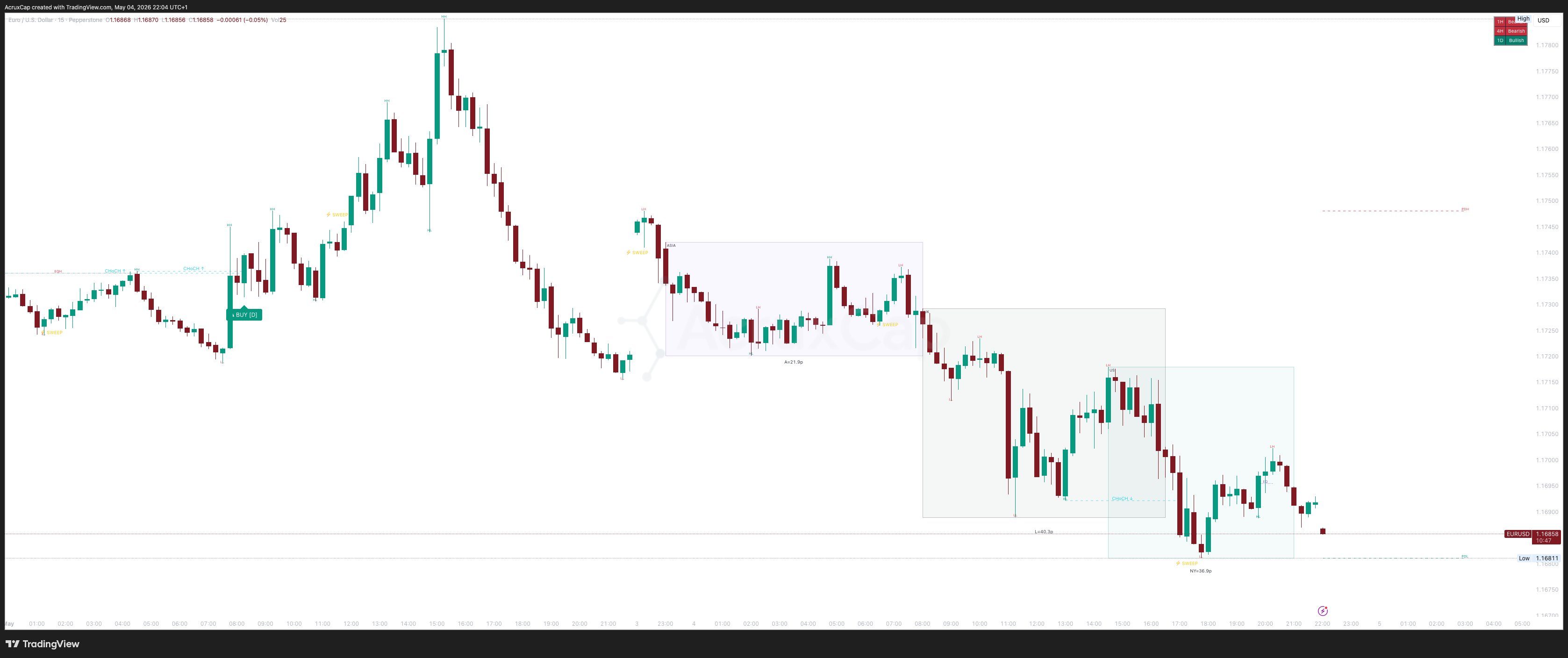
Sweep & Shift
Sweep & Shift automates sweep detection in real time — monitoring session highs and lows, previous day levels, equal highs and lows, and equilibrium for institutional sweep events. Each sweep is classified as Minor, Medium, or Standard. CHoCH confirmation is drawn automatically. Six alert conditions including bullish sweep, bearish sweep, and displacement signals support webhook integration.