What Divergence Is and Why It Works
Divergence occurs when the direction of price movement and the direction of a momentum indicator disagree. Bearish divergence: price makes a higher high while the oscillator makes a lower high. Bullish divergence: price makes a lower low while the oscillator makes a higher low. The divergence signals that the momentum behind the current price move is weakening — the move is continuing but with less force behind it.
The reason divergence works as a leading indicator relates to how momentum precedes price. In a healthy uptrend, each successive high is accompanied by equal or greater buying momentum. When price makes a new high but buying momentum is declining, it signals that the uptrend is approaching exhaustion. Divergence is not infallible — in strong trending markets it can persist through multiple higher highs before the reversal finally occurs. This is why divergence alone should never be a complete strategy; it requires additional filters that confirm the reversal is actually beginning.
RSI Divergence
The Relative Strength Index is the most commonly used divergence tool. It measures average gain versus average loss over a configured period, producing a reading between 0 and 100. Divergence identification on RSI requires connecting RSI pivot highs to RSI pivot lows over a minimum bar separation — typically 5 or more bars between pivots to filter micro-divergences that appear in noise.
The strongest RSI divergence setups occur in contextually appropriate locations — bearish divergence at a resistance level, bullish divergence at a support level, or either in a premium or discount zone respectively. Divergence in the middle of a range carries less conviction than divergence at an extreme, because there is no structural reason for a reversal in the middle of a range.
Multi-Timeframe MACD Alignment
A single-timeframe MACD signal tells you about momentum on that timeframe only. Multi-timeframe MACD alignment — checking whether the MACD on a higher timeframe is also pointing in the direction of the trade — significantly improves signal quality by ensuring the trade aligns with larger-scale momentum.
Strong MTF alignment occurs when both the chart timeframe and the higher timeframe MACD are bearish for a sell signal, or both bullish for a buy. Background colouring in the oscillator pane reflecting MTF regime — green for bullish, red for bearish, neutral for mixed — provides instant context without requiring the trader to manually check a higher timeframe chart.
Liquidity Sweeps as Triggers
A liquidity sweep preceding a divergence signal is among the most powerful combinations the methodology produces. The sweep eliminates trapped traders and creates a fresh supply of orders in the direction of the reversal. When this is followed immediately by a momentum signal confirming the reversal, both the trigger and the confirmation are present.
The sweep provides the "where" — a specific price at which institutional activity occurred. The divergence provides the "why" — momentum confirming that the reversal has force behind it. Sweep markers flag when a sweep event has occurred. A sweep marker followed within a few bars by a divergence signal is the highest-conviction pattern the momentum framework produces.
Premium and Discount Zones
A divergence signal in the middle of the recent price range carries less conviction than one at an extreme. Premium zones are the upper third of the range over a configured lookback period. Price in the premium zone is statistically overextended to the upside. Bearish divergence in the premium zone aligns momentum exhaustion with positional overextension — a more complete reversal argument.
The discount zone is the lower third. Bullish divergence in the discount zone combines momentum reversal with price at a statistically low point in the recent distribution. Signals in the middle third carry a lower confluence score, reflecting lower conviction of a reversal in neutral territory.
Signal Grading: A and A+
The grading system quantifies the quality of each signal based on how many of the nine confluence engines are in agreement. A Grade A signal meets the base threshold — enough engines agree to constitute meaningful confluence. A Grade A+ signal meets the higher threshold — nearly all engines are in agreement simultaneously, which is rare and represents the highest quality signals the system produces.
Grade A+ signals are rare by design. If the threshold is set appropriately, true A+ signals should appear a handful of times per week at most. When they appear at a sweep location, in the correct premium or discount zone, with MTF alignment, after a clear divergence, they represent the highest-quality opportunity the methodology can identify.
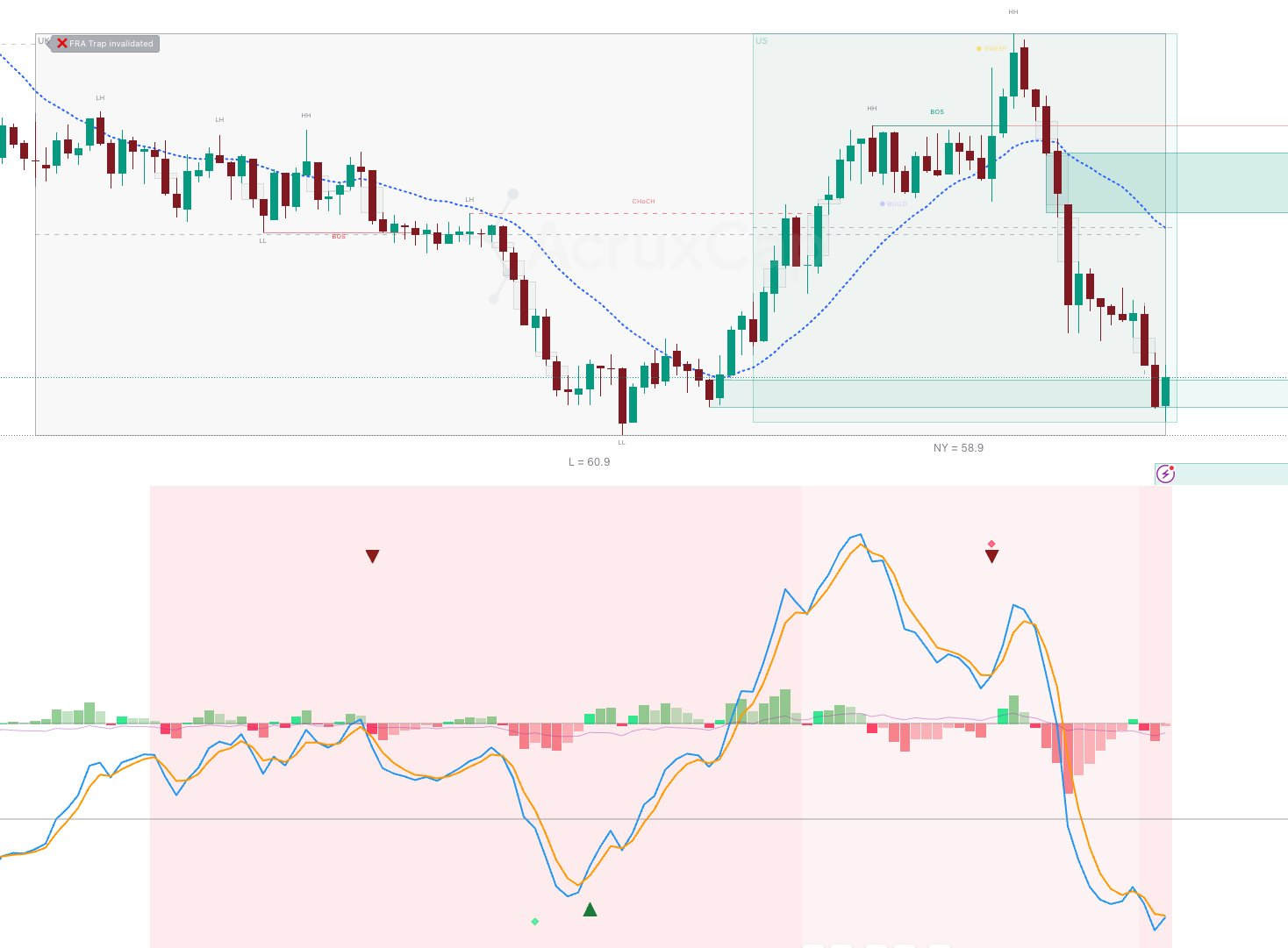
Momentum Divergence Oscillator
The MDO scores nine independent engines simultaneously — multi-timeframe MACD, liquidity sweeps, RSI divergence, RSI extremes, premium/discount zones, histogram momentum, change of character, conditional MACD zero cross, and session filter. Signals grade A or A+ based on confluence score. Auto-calibrates all parameters by timeframe. Six alert conditions with webhook support.