The Five Phases
Richard Wyckoff observed that markets move in identifiable phases — not randomly, but in cycles driven by the accumulation and distribution of positions by large operators. Markets cycle through periods of trending (Markup and Markdown), periods of repositioning (Accumulation and Distribution), and periods of genuine uncertainty (Transition).
The practical value of phase identification is context. An entry signal that fires during a Markup phase — when the dominant institutional flow is bullish — carries much higher probability than the same signal firing during a Transition phase where direction is unresolved. The signal is the same; the context that determines its quality is different. Most traders focus almost entirely on entry signals and ignore phase context. Understanding phase context allows traders to apply the same signal methodology selectively — trading aggressively when conditions are favourable and reducing activity when they are not.
Markup and Markdown
The Markup phase is defined by sustained upward movement with expanding momentum. In EMA terms: fast EMA above mid above slow, all pointing upward, with the cloud between mid and slow EMAs expanding. The cloud expansion reflects increasing momentum — the trend is not just continuing but accelerating.
During Markup, the primary trade is long. Pullbacks to the cloud or key structural levels are buying opportunities. Counter-trend signals should be ignored or traded with greatly reduced conviction. Markdown is the mirror image — fast below mid below slow, all declining, expanding cloud below price. Short signals carry higher probability; long signals should be filtered aggressively or avoided.
Accumulation
Accumulation occurs after a Markdown phase. The downtrend has exhausted itself; price is forming a base rather than making new lows. In EMA terms: bearish EMA order but with the EMAs no longer all declining. The momentum of the downtrend is fading even though the structural configuration still reflects the prior trend.
This is critical — Accumulation is not the same as a bullish phase. The market has not yet turned bullish; it is in the process of turning, with institutions gradually absorbing the supply that Markdown created. Trading longs during Accumulation is premature; trading shorts is fighting an exhausted trend. The appropriate posture is reduced activity and patience.
Distribution
Distribution is the mirror of Accumulation — a bullish EMA configuration but with the momentum of the uptrend fading. The fast EMA is no longer accelerating away from the slow EMA; the cloud is compressing rather than expanding. Institutions that accumulated during the prior phase are beginning to distribute — gradually selling their positions into retail buying.
Distribution is deceptive. The EMA order is still bullish, which misleads trend-following traders into holding or adding to long positions. The compressing cloud and slowing momentum are the tell — the uptrend is losing institutional support. Aggressive long entries during Distribution carry poor timing; the move is likely closer to its end than its beginning.
Transition
Transition occurs when the EMAs are tangled — no clear order exists between fast, mid, and slow. This reflects genuine market indecision: neither bulls nor bears have established dominance. Transition frequently occurs at the border between phases — during the late stage of Accumulation before Markup begins, or in the late stage of Distribution before Markdown takes hold.
The appropriate response is patience. Both long and short signals carry lower probability during Transition because the macro context is unresolved. Many traders find that filtering signals to exclude Transition periods dramatically improves their results — not because they are taking fewer trades, but because they are avoiding the highest-noise condition the market produces.
Reading the EMA Cloud
The EMA cloud — the shaded area between the mid and slow EMAs — is the primary visual element for phase identification. Its width and direction communicate both the current phase and the momentum within that phase. A wide, expanding teal cloud means strong Markup with increasing momentum. A wide, expanding red cloud means strong Markdown. A narrow, compressing cloud means the phase is maturing and momentum is fading.
Phase duration tracking adds another dimension. A Markup phase active for 50 or more bars is Exhausted — statistically more likely to transition than one active for 10 bars (Early) or 30 bars (Mature). An Early Markup with an expanding cloud is a very different situation from an Exhausted Markup with a compressing cloud, even though both technically qualify as the same phase.
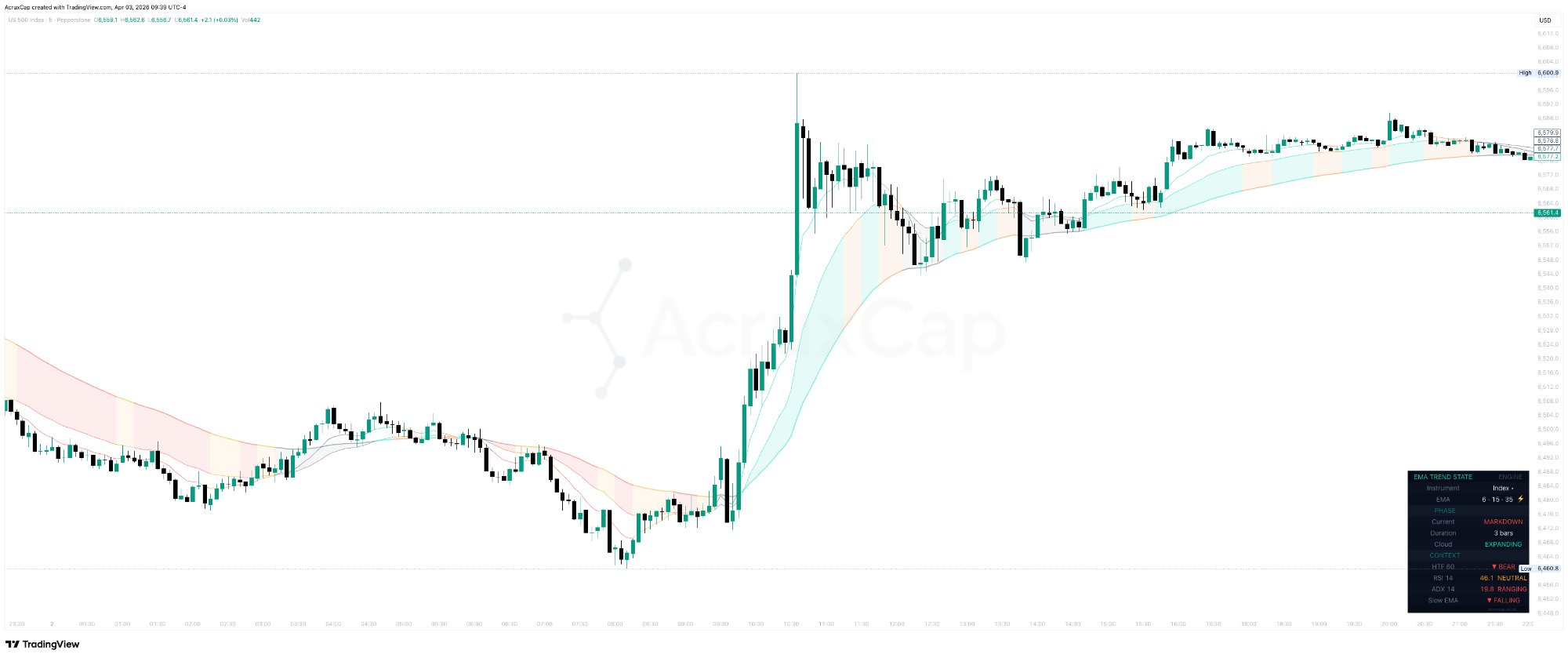
EMA Trend State Engine
EMA Trend State Engine classifies the market into five Wyckoff-inspired phases using a state machine that enforces correct phase ordering — Accumulation can only follow Markdown, Distribution can only follow Markup. Adaptive EMA lengths scale with volatility. Auto-detects instrument class. Phase alerts include JSON webhook data with new phase, previous phase, ticker, and bar count.