What the Hull Moving Average Is
The Hull Moving Average was developed by Alan Hull in 2005 to address the fundamental tension in moving average design: smoothness versus responsiveness. Standard moving averages are smooth because they average out noise — but that averaging process also means they respond to price changes slowly, creating lag. A fast moving average reduces lag but amplifies noise. A slow moving average reduces noise but increases lag.
The HMA resolves this by using a weighted moving average of two different-period WMAs and then applying a square root of the period as the final smoothing length. The mathematical effect is a moving average that tracks price closely — almost like a fast EMA — but with significantly less noise and without the whipsaw signals that fast EMAs produce in sideways markets. In practical terms, the HMA turns direction faster than an equivalent-period EMA when price reverses, and remains pointed in one direction longer during trends.
HMA vs EMA: The Lag Problem
The lag problem in moving averages is more significant than most traders appreciate. A 20-period EMA on a 5-minute chart is not telling you what price is doing now — it is telling you what price was doing on average over the past 20 bars. In a fast-moving market, 20 bars can represent 30–40 points of movement on an index. By the time the EMA signals a directional change, a significant portion of the move is already complete.
EMA crossovers consistently produce late entries and early exits. The crossover typically occurs well after the price reversal has begun. The HMA addresses this by reducing lag dramatically. On the same timeframe with the same nominal period, an HMA crossover signals the directional change earlier and with more conviction — giving a better entry with more remaining potential.
Why Triple-HMA Works
A single HMA, while superior to a single EMA, still produces false signals in sideways markets. The triple-HMA system uses three HMAs — fast, mid, and slow — to add layered confirmation. Signals fire on the fast HMA crossing the mid HMA, providing early entry timing. But they only fire when the slow HMA is already aligned in the direction of the signal — providing macro trend confirmation.
This means the system does not fire on every fast/mid crossover; only on those occurring in the direction of the dominant trend as defined by the slow HMA. The result is fewer signals, but with higher average quality. In a strong trend, signals fire frequently and follow through consistently. In a ranging market, the slow HMA oscillates, and the confirmation requirement filters out the majority of false crossovers.
Composite Signal Scoring
Even with triple-HMA confirmation, not all signals carry the same quality. Six independent components contribute to the score. HTF confluence contributes up to 25 points. Volume relative to its 20-bar average contributes up to 15 points. RSI momentum positioning contributes up to 20 points. HMA mid-line slope acceleration contributes up to 20 points. Market structure — whether higher highs and higher lows are forming — contributes up to 20 points. RSI and MACD divergence detection adds a bonus of up to 10 points when present.
Signals are displayed with their score. Higher scores do not guarantee winning trades, but they identify the subset of signals with more confluent conditions. Traders who restrict entries to signals scoring 65 or above take fewer trades but achieve better average outcomes.
Adaptive Lengths and Volatility
A fixed-length HMA that works well on a trending day may be too fast during a low-volatility session — producing noise — or too slow during a high-volatility session — missing the move. Adaptive length management scales the HMA periods to current volatility conditions using a 100-bar ATR ratio: current ATR divided by the 100-bar average ATR.
When current volatility is below average, the HMA lengths expand to filter extra noise. When above average, they contract to stay responsive. The adaptation is clamped between 0.7x and 1.4x the base length, preventing extreme adjustments. The practical benefit is a system that self-calibrates to market conditions without manual intervention across different session types.
Multi-Instrument Detection
Different instruments have different volatility characteristics and typical trend structures. A HMA period calibrated for gold is too short for a slow-moving bond and too long for a volatile small-cap. Rather than requiring manual configuration, multi-instrument detection reads the ticker and applies appropriate defaults automatically.
US indices get shorter HMA lengths and session filtering. Forex pairs get lengths calibrated to pip-scale volatility. Crypto gets 24-hour filtering with lengths adjusted for higher volatility. The auto-detection covers the vast majority of liquid instruments; a manual override is available for non-standard tickers.
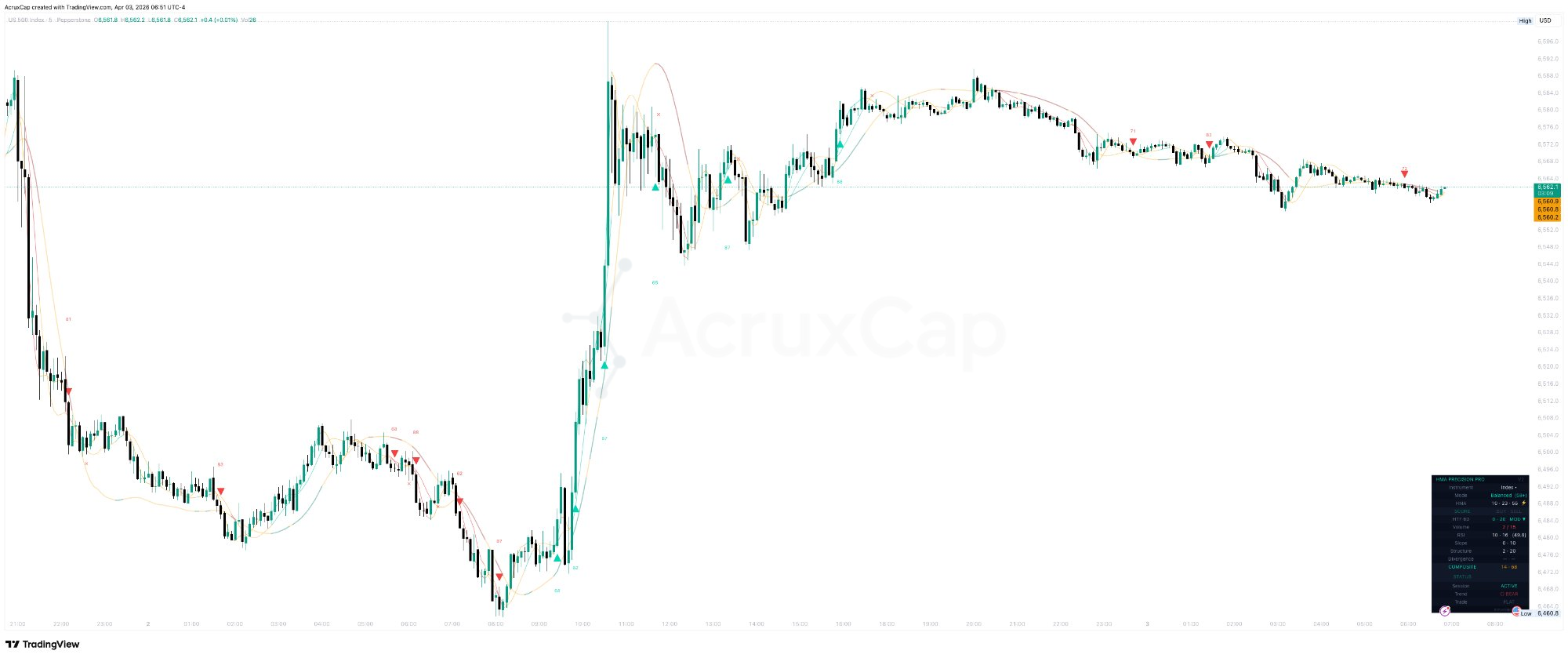
HMA Precision Pro
HMA Precision Pro implements adaptive triple-HMA crossover with six-component scoring up to 100. Every signal displays its score on the chart. Trade lifecycle tracking marks TP1, TP2, stop hit, and invalidation. Eight webhook-ready alerts with full JSON payload. Multi-instrument detection covers indices, forex, crypto, and commodities with auto-tuned defaults.