What the Opening Range Is
The opening range is the high and low established during the first minutes of the US regular trading session — typically the 9:30–9:45 ET window. During this window, market makers are setting quotes, institutions are rebalancing overnight books, and retail traders are reacting to pre-market news. The resulting high and low define the initial balance of the session.
When price subsequently breaks above the opening range high with conviction, it signals that buyers have overcome the initial supply at the top of the range. When price breaks below the opening range low, sellers have overcome initial demand. The ORB strategy is built on the hypothesis that confirmed breaks, when accompanied by sufficient displacement, tend to follow through — a hypothesis well-supported by intraday flow dynamics in US equity markets.
Why ORB Works and Why It Fails
The ORB works because institutional participants who could not execute during pre-market hours are forced to participate at the open. Large buy programs create momentum above the ORB high; large sell programs create momentum below the ORB low. This institutional flow, when directionally committed, drives sustained moves that make ORB setups profitable.
It fails for two primary reasons. First, not every session has institutional commitment. On low-conviction days — thin pre-market volume, no significant catalyst, mixed data — the opening range breaks and reverses repeatedly. A trader executing every ORB signal on every day gets destroyed on these sessions. Second, most ORB implementations use fixed stop distances that do not account for the day’s actual volatility. Fixed stops on a dynamic instrument produce inherently inconsistent results.
Session Quality Grading
Session quality is the most important variable in ORB trading, and the one most commonly ignored. A Grade A session — above-average volume at the open, a clear directional pre-market move, a well-defined ORB range — produces high-conviction setups with strong follow-through. A Grade C session produces false breakouts and stop hunts.
The inputs that determine session grade are calculable: the ORB range relative to the ATR, the opening volume relative to its 20-day average, the size of the pre-market gap, and the clarity of the ORB candle’s directional bias. These factors, scored at the close of the ORB window, produce a grade before any signal has been taken. On Grade A sessions, take signals with full conviction. On Grade B sessions, reduce size. On Grade C sessions, stand aside.
Institutional Confluence
An ORB breakout that aligns with a previous day high, a pre-market extreme, and a round number is a different situation from a breakout through an isolated level. Each level type represents a different pool of orders. When two or more coincide, the combined order flow at that price is larger — reactions tend to be sharper and more sustained.
Institutional confluence signals are the highest-conviction setups the ORB strategy produces. They are rare by design — most sessions will not have three or more levels aligned with the ORB boundary. When they do appear, they warrant full attention and full size on a Grade A or B session.
The Break and Retest Entry
The break and retest model waits for price to break beyond the ORB high or low with displacement, then watches for a retest of the broken level before entering. This approach improves entry quality at the cost of occasionally missing fast moves that do not provide a clean retest.
The displacement requirement is critical. A breakout on a single weak candle does not constitute genuine displacement. The breakout candle should be directionally decisive — a strong close in the direction of the break, with the body occupying a significant proportion of total range. This filters the false breakouts that trap retail traders who enter on the first touch of the ORB level. The stop is placed below the retest low with a buffer, and the target is the next significant level above: a previous day high, a weekly level, or a structural supply zone.
The One Candle Rule
If price breaks the ORB level cleanly and moves away without providing a retest, the initial opportunity has passed. However, a secondary entry model remains available. Identify the first counter-trend candle that forms near the broken ORB level after the initial move. When the next candle closes back in the direction of the breakout past the high or low of that counter-trend candle, the retracement has completed and the move is ready to resume.
This secondary entry has a slightly worse risk profile than the original retest entry — the stop must be placed below the counter-trend candle’s extreme rather than below the ORB level. But it still offers a positive risk-to-reward setup on continuation days and is worth applying when the primary entry was missed.
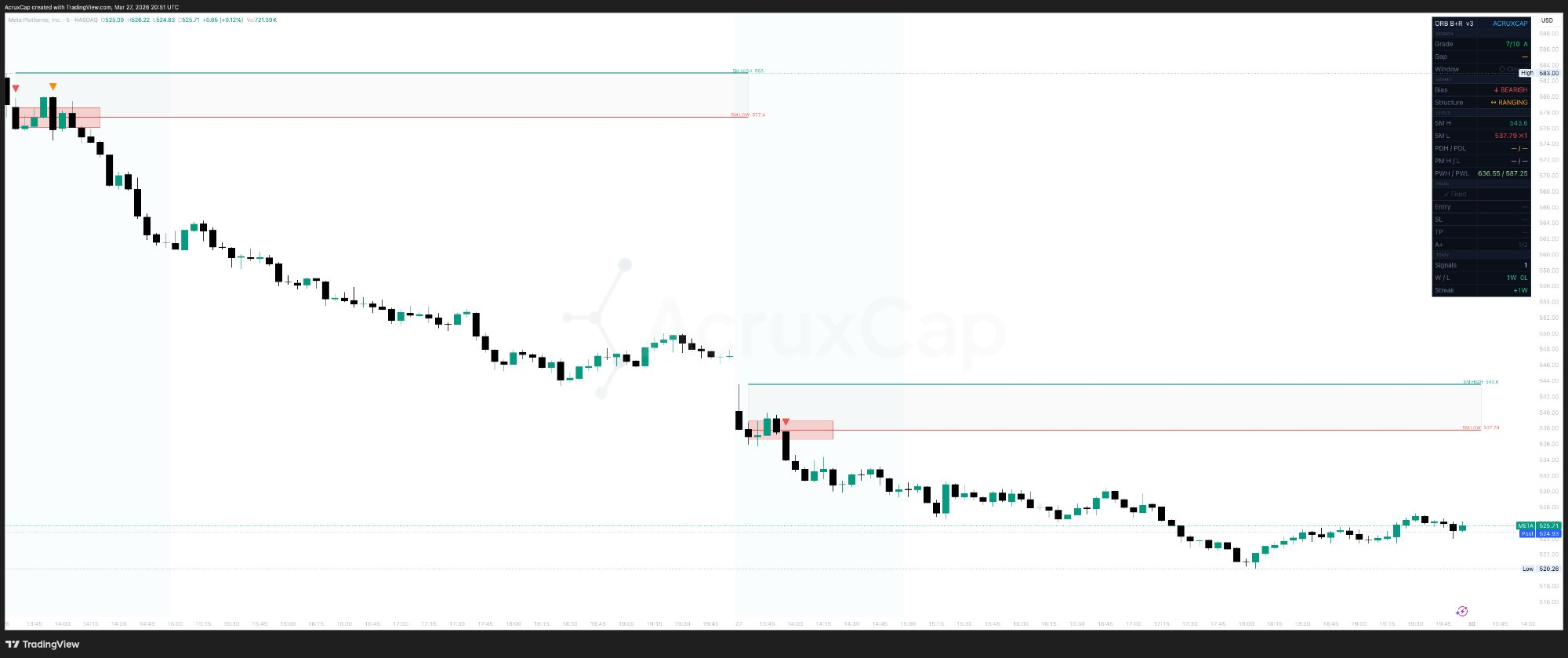
Opening Range B+R
Opening Range B+R captures the full ORB framework in a single TradingView overlay — session grading A–C, institutional confluence detection across five level types, ATR-based dynamic stops, and the One Candle Rule secondary entry. Dashboard updates in real time with grade, bias, trade status, SL, TP, and intraday P&L. Designed for the 1-minute chart on US equities and indices.